Why Canopy Materials Matter: Putting Safety and Quality First
You may have recently seen reports concerning a serious fire at an academy in Norfolk. The accidental fire, which occurred during the summer holidays, caused extensive damage to three classrooms and has understandably raised questions about the safety of outdoor canopies in schools.
Norfolk Fire Service subsequently determined that the fire was caused by refracted sunlight from a Perspex canopy situated within the school’s reception outdoor area.
Firstly, and most importantly, we were relieved to hear that nobody was injured during the incident. We would also like to reassure you that the canopy involved was not supplied or installed by Able Canopies.
While incidents such as this can understandably cause concern, it is important to put the event into context. In more than 20 years of supplying and installing commercial canopies across the UK, this is the first time we have heard of a fire involving a canopy being caused in this way. It therefore appears to be an extremely rare occurrence.
However, it does highlight an important consideration when investing in any permanent outdoor structure: the quality and specification of the materials used matter.
Perspex and Polycarbonate Are Not the Same Material
Transparent plastic roofing materials can sometimes look similar, but their properties and performance can differ considerably.
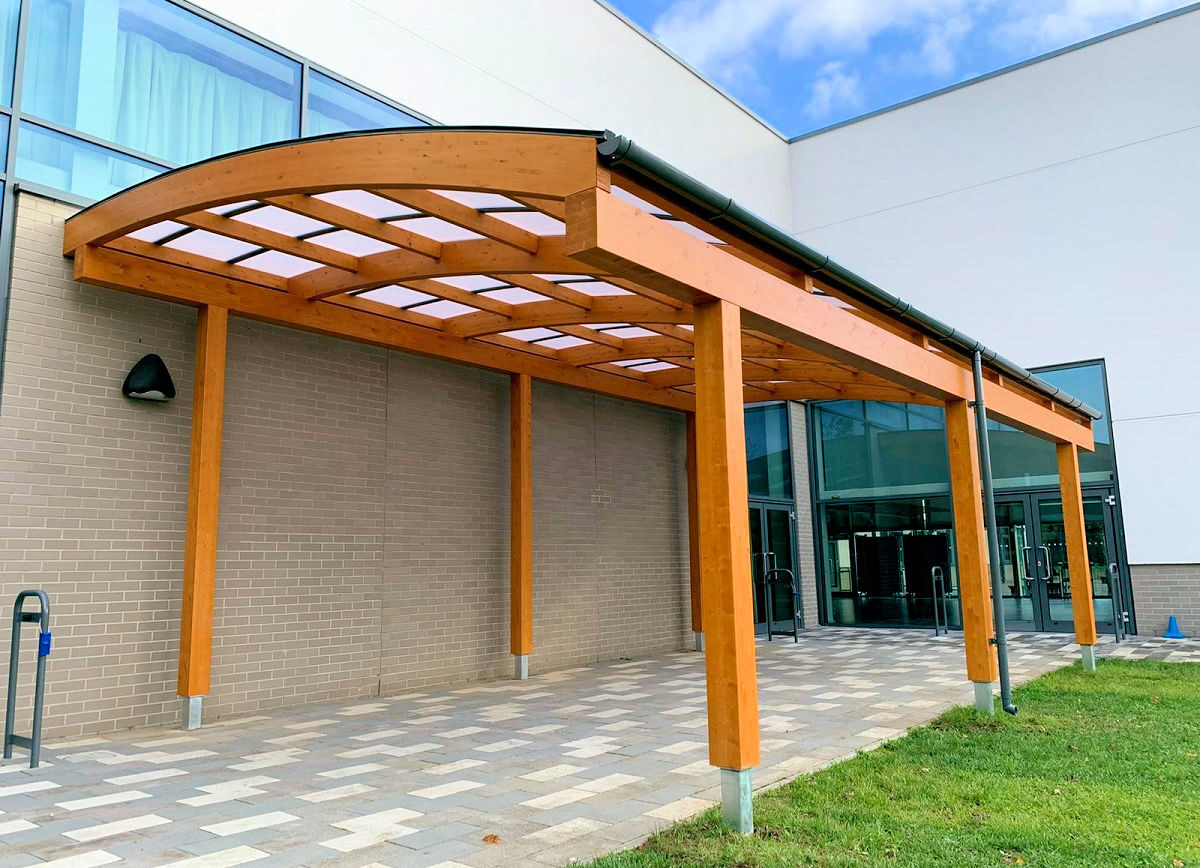
At Able Canopies, our permanent canopy ranges are manufactured using carefully selected commercial-grade materials. Our timber canopies, for example, use robust polycarbonate roof panels rather than Perspex.
Polycarbonate is widely used within the construction industry because of its combination of strength, durability and impact resistance. The polycarbonate roofing systems specified for our canopies are selected to meet applicable standards, with detailed product specifications available so customers, architects and contractors can understand exactly what is being supplied.
Our Tarnhow timber canopies combine high-quality polycarbonate roofing with a strong Glulam timber structure, with both materials having recognised reaction to fire classifications.
The polycarbonate roofing has a Reaction to Fire Class B-s2,d0, which means:
- B – it has a very limited contribution to fire.
- s2 – it produces a moderate amount of smoke when exposed to fire.
- d0 – it produces no flaming droplets or particles.
The Glulam timber used within our timber canopies has a Reaction to Fire Class D-s2,d0, which means:
- D – it has a medium contribution to fire; it resists low-flame ignition for a long time without fast flame spread.
- s2 – it produces a moderate amount of smoke when exposed to fire.
- d0 – it produces no flaming droplets or particles.
These classifications provide customers and specifiers with clear information about how the materials used within our canopy systems perform when exposed to fire, helping them make an informed decision when comparing products and suppliers.
Look Beyond the Initial Price of a Canopy
When budgets are under pressure, particularly within schools and the public sector, choosing the lowest-priced quotation can understandably be tempting. However, a cheaper canopy is not necessarily the most cost-effective option over its lifetime.
The initial purchase price is only one part of the overall investment. Material quality, structural design, expected lifespan, maintenance requirements, guarantees, installation standards and safety should all form part of the purchasing decision.
A structure that is cheaper initially but uses lower-quality materials, has a shorter lifespan or requires more maintenance and replacement work may ultimately cost considerably more in the long term. Not to mention the health and safety risks involved with a product with low-quality materials and poor design.
Most importantly, safety should never be compromised to achieve a lower initial price.
Check the Specification Before You Buy
One of the simplest ways to make a more informed decision when comparing canopy suppliers is to browse their website or brochure and examine the actual product specification.
A reputable commercial canopy supplier should be open about the materials and specifications of its products and give the information away freely.
Before choosing a supplier, we recommend checking whether they clearly publish information such as the roof material, frame material, relevant fire classifications and standards, structural information, expected lifespan and guarantees.
If this information is not readily available on their website or technical literature, ask for it before you consider placing an order.
At Able Canopies, we publish detailed specifications for our canopy systems on our website and make technical product data available to architects, contractors, schools and other customers. This transparency allows customers to understand what they are investing in and enables specifiers to assess whether a product is appropriate for their project.
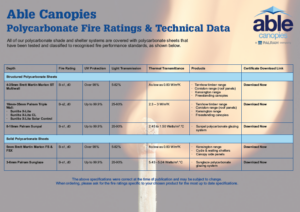
DOWNLOAD THE POLYCARBONATE FIRE RATINGS FACT SHEET
Choose a Specialist Canopy Supplier
A permanent canopy is a significant structure that may remain in place for decades, particularly in busy environments such as schools, hospitals and commercial premises. It therefore makes sense to purchase from a reputable company that specialises in the design, manufacture and installation of canopy systems.
Able Canopies has been supplying and installing commercial canopies throughout the UK for more than 20 years. Throughout that time, our focus has remained on providing high-quality structures that are designed for their intended environment and manufactured from carefully specified materials.
The recent incident at the Academy in Norfolk appears to have been extremely unusual, and it should not cause schools to be unnecessarily concerned about properly designed and specified canopy systems.
Instead, it serves as an important reminder that not all canopies – and not all roofing materials – are the same.
When comparing canopy quotations, look beyond the price. Check the materials, review the technical specifications, ask about relevant standards and choose an experienced, specialist supplier.
Because when a structure is being installed within an environment used by children, staff and visitors every day, quality and safety should always come first.
*Fire classifications can vary according to the specific polycarbonate product, thickness and finish specified. Please refer to the relevant Able Canopies product data sheet for the classification applicable to your chosen canopy.

Able Canopies Ltd. design, manufacture and install commercial grade canopies, shade sails, awnings and shelters across the UK. We specialise in servicing the education, leisure, healthcare and retail sectors and have extensive experience working with schools, councils, architects and contracting firms.
For more information on our products and services please contact us
Follow us on our social media accounts for the latest funding advice, new products & latest news:
Twitter | Facebook | LinkedIn | Instagram
Categories
- 20 Years of Able Canopies
- Canopies for Architects & Contractors
- Canopies for Healthcare
- Canopies for Restaurants, Bars and Hotels
- Canopies for Retail & Commercial
- Canopies for Schools
- Canopies for Sports & Leisure
- Canopy Maintenance
- Case Studies
- Cool Links & Facts
- Cycle Parking Solutions
- Dates for Your Diary
- Eco-Friendly Holiday Crafts
- Employee Spotlight
- Environmental Tips
- Funding and Fundraising
- How to... Get the Most out of Your Canopy
- Insights: Able Canopies News
- Latest News
- Latest Stories
- Lockdown Outdoor Learning & Play Ideas
- MD News
- Newsletters - Academies
- Newsletters - Architects & Contractors
- Newsletters - Schools & EYFS
- Outdoor Learning
- Outdoor Play
- Planning Your Cycle Parking
- Product Focus
- Solar Carports
- Spring Fundraisers 2017
- Summer Shade
- The Good Canopy Guide
- Uncategorised
- Wall Mounted Canopies